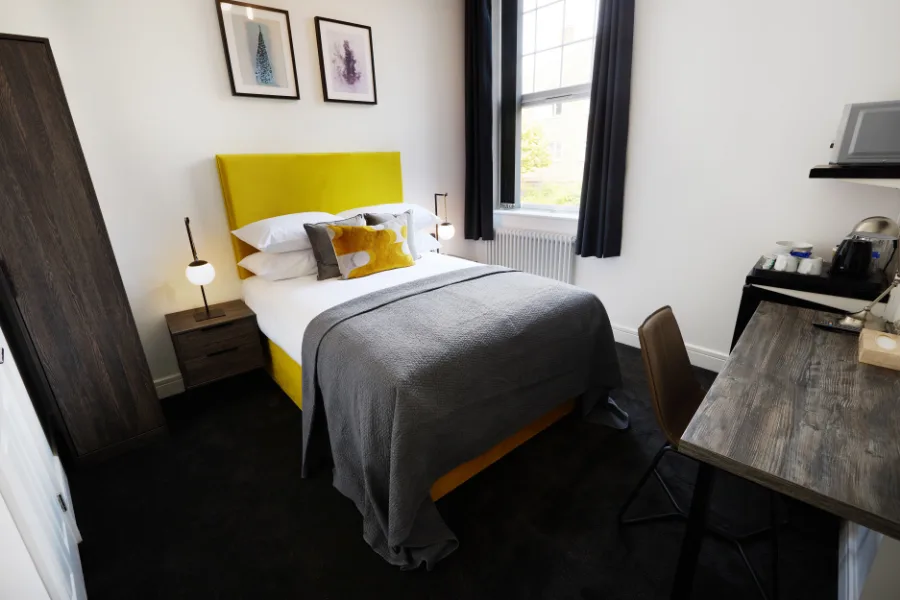
Running A Co-Living Property In Malaysia: Pricing, House Rules And Operations
Co-living is a hospitality business wearing a tenancy agreement. What changes when you rent by the room, and the operational habits that keep it profitable.

Co-living looks like renting a unit and behaves like running a small hospitality business. You have more tenants, shorter stays, shared space that nobody individually owns, and an operating rhythm closer to a hotel than a tenancy.
This article covers what changes when you rent by the room, and the habits that keep it profitable.
The Economics Are Genuinely Different
Splitting a unit into rooms usually raises gross income substantially — a three-bedroom apartment let as three rooms typically earns more than the same unit let whole. That is the attraction, and it is real.
What the headline misses is that costs rise too:
- Utilities are usually included, so consumption is your cost rather than theirs
- Cleaning of shared areas is a recurring operating expense
- Furnishing is per room, plus the shared spaces
- Turnover is more frequent and happens per room, not per unit
- Wear on kitchens and bathrooms is a multiple of single-household use
- Management time per unit is several times higher
The net is still generally favourable, but the margin is narrower than the gross suggests. Model it properly before converting a unit, and model it with realistic vacancy — a room empty for six weeks is a much larger proportional loss than a unit empty for six weeks.
Occupancy Is The Whole Business
In co-living, occupancy is measured by room-nights, and the arithmetic is unforgiving. A four-room unit with one room empty is at 75% occupancy, and that missing room often represents most of the profit.
Track:
- Room-night occupancy monthly, per property
- Average length of stay
- Days between one resident leaving and the next arriving
- Enquiry-to-booking conversion
The third metric is the one operators most often ignore and most easily improve. A room that could turn over in three days but takes three weeks is losing income to process, not to demand.
Pricing Per Room
Rooms in the same unit are not equivalent, and pricing them identically leaves money on the table while making the worst room hard to fill.
Price on the attributes residents actually pay for:
- Private bathroom versus shared
- Room size and whether a double bed fits
- Window, natural light and outlook
- Proximity to the kitchen or the entrance — usually a negative
- Air conditioning and included furnishing
A sensible spread between the best and worst room in a unit makes the whole unit fill faster. The premium room subsidises the difficult one, and both let.
House Rules Are The Product
In shared living, the rules are not administrative overhead — they are what the resident is buying. Someone choosing co-living over a whole unit is choosing a managed environment, and the management is the difference.
Cover explicitly:
- Quiet hours
- Guests — whether permitted, how many, how long, overnight or not
- Cleaning responsibilities for shared areas, and what is done by the operator
- Kitchen use and food storage
- Smoking and alcohol
- Use of common areas and any booking system
- What happens when rules are broken
Have every resident acknowledge them at move-in. Rules stated once and never enforced are worse than no rules, because residents who followed them resent it, and those who did not learn that nothing follows.
Managing Conflict Between Residents
This is the operational reality of co-living and the part most new operators underestimate. Noise, cleanliness, guests and kitchen use generate the overwhelming majority of complaints.
What works:
- Have a channel for raising it. Residents who cannot report a problem to you will either confront each other or leave.
- Respond quickly and visibly. Silence is read as endorsement of whoever is causing the problem.
- Enforce identically. Selective enforcement destroys the operator's authority faster than no enforcement.
- Be willing to end a tenancy. One resident who makes the unit unpleasant will cost you every other room in it.
That last point is the hardest and the most important. The cost of removing a disruptive resident is one room; the cost of keeping them is often the whole unit.
Utilities Included, But Not Unlimited
Almost all co-living includes utilities, because per-room metering is impractical. That transfers consumption risk entirely to the operator.
Manage it by:
- Stating a fair-use cap in the agreement, with the excess recoverable
- Monitoring consumption monthly against a baseline for the unit
- Investigating spikes promptly — usually a portable air conditioner, a leak, or an unauthorised occupant
- Specifying efficient appliances and inverter air conditioning at fit-out
A cap that is never enforced is decorative, but its existence gives you a basis for a conversation when one unit consumes twice what comparable units do.
Turnover Is Constant, So Systematise It
With four rooms and an average stay of eight months, a single unit turns over six times a year. Across five units that is thirty move-ins and thirty move-outs annually — each with an agreement, a deposit, an inventory, a key handover and a cleaning slot.
Handled ad hoc, this consumes the operator entirely. A standard checklist for each direction, run the same way every time, is what makes the volume manageable:
- Move-out: inspection, deposit assessment, key recovery, clean scheduled
- Turnaround: clean, repairs, restock, photograph, relist
- Move-in: agreement signed, deposit received, inventory acknowledged, rules acknowledged, keys issued
Check The Building Permits It
Before converting anything, confirm the position. Many management corporations restrict room-by-room letting, cap occupancy, or prohibit short stays outright, and house rules for the building override your commercial plan.
Local authority requirements may also apply depending on the property type and the arrangement. Establishing this at the outset costs a phone call. Establishing it after fit-out, from a complaint, costs the fit-out.
Ready To Simplify Property Management?
Manage properties, collect rent and track maintenance from one platform built for landlords, property managers and rental operators.