10 Common Mistakes First-Time Landlords Make
Most first-year losses are not bad luck. They come from a short list of avoidable decisions made before the first tenant moves in.

Most first-year losses in rental property are not caused by bad luck or bad tenants. They come from a short list of decisions made before anyone moved in — and nearly all of them are avoidable once you know to look for them.
Here are the ten that cost new landlords the most.
1. Budgeting From The Purchase Price
The purchase price is the largest number in the transaction and the least complete. Transfer stamp duty, loan stamp duty, two sets of legal fees, service tax, disbursements and valuation together can add several per cent to what completing actually costs.
New landlords who budget the down payment and nothing else find themselves short at exactly the moment the money is due. Cost the full transaction before making the offer, not after accepting it.
2. Assuming Twelve Months Of Rent
A property that lets for ten months of the year earns a sixth less than the same property modelled at full occupancy. Voids happen between tenancies, during make-good, and whenever the market is slow.
Build a vacancy assumption into every projection from the beginning. A return that only works at 100% occupancy is a return that does not work.
3. Skipping Tenant Screening
Screening feels like an obstacle when a unit has been empty for six weeks and someone is standing in front of you with a deposit. It is the single highest-value hour a landlord spends.
Verify employment and income, take previous landlord references, and confirm identity. A tenant who objects to reasonable checks is telling you something useful. One month of unpaid rent costs many times what any check does.
4. Accepting A Verbal Agreement
Family, friends and friends-of-friends are where this happens most, and it is where it goes wrong most. Without a written agreement, the due date, the deposit terms, the repair split and the notice period are all matters of recollection.
Put every tenancy in writing, including — especially — the ones that feel too friendly to need it. Get it stamped.
5. No Inventory And No Photographs
Almost every deposit dispute is an argument about the condition of the property when the tenant moved in. That argument is unwinnable without evidence and trivially settled with it.
Photograph every room, every appliance and every existing mark at handover. List the fixtures and their condition, and have both parties sign the list. It takes an hour and it resolves disputes in minutes.
6. Treating The Deposit As Rent
Allowing a tenant to skip the final month's rent "against the deposit" leaves nothing to cover damage, cleaning or unpaid utilities — which is what the deposit is for.
Keep the deposit separate in your accounting and out of your rent conversations. Whether it is ultimately applied against arrears is a decision made at the end, on the full picture.
7. Underestimating Maintenance
Air conditioning units, water heaters, washing machines and paint all have finite lives. Treating their replacement as an unexpected event does not make it less certain — it just means it is unbudgeted when it arrives.
Set aside a fixed proportion of rent for maintenance and replacement from the first month. A landlord with a reserve makes decisions on the merits; a landlord without one defers repairs, and deferred repairs cost more and lose tenants.
8. Being Slow On Repairs
Slow repairs are expensive twice. The problem gets worse — a small leak becomes a ceiling — and the tenant, who was going to renew, decides not to.
A good tenant who stays another year saves you a void period, a make-good and a re-listing. Responsiveness is not generosity; it is the cheapest tenant retention available.
9. Pricing By Hope
Setting rent from what you need the property to earn, rather than what comparable units are letting for, produces long voids. A unit priced ten per cent above the market does not earn ten per cent more — it earns nothing while it sits empty, and the lost months are rarely recovered.
Research genuinely comparable properties: same area, similar size, similar condition and furnishing. Price to let within a reasonable window, then hold firm on quality of tenant rather than on the number.
10. Managing It All In Your Head
With one property, remembering when rent is due and when the tenancy ends is manageable. With three, it is not, and the failure is silent — a renewal date missed, an arrears balance noticed a month late, a maintenance charge never passed on.
The specific costs of disorganisation are consistent:
- Arrears discovered late, when the amount is already too large for a tenant to clear
- Tenancies rolling over on old terms because nobody diarised the review
- Recoverable costs never invoiced because no record connected them to a tenant
- No usable figures at tax time, and no way to tell which property is actually performing
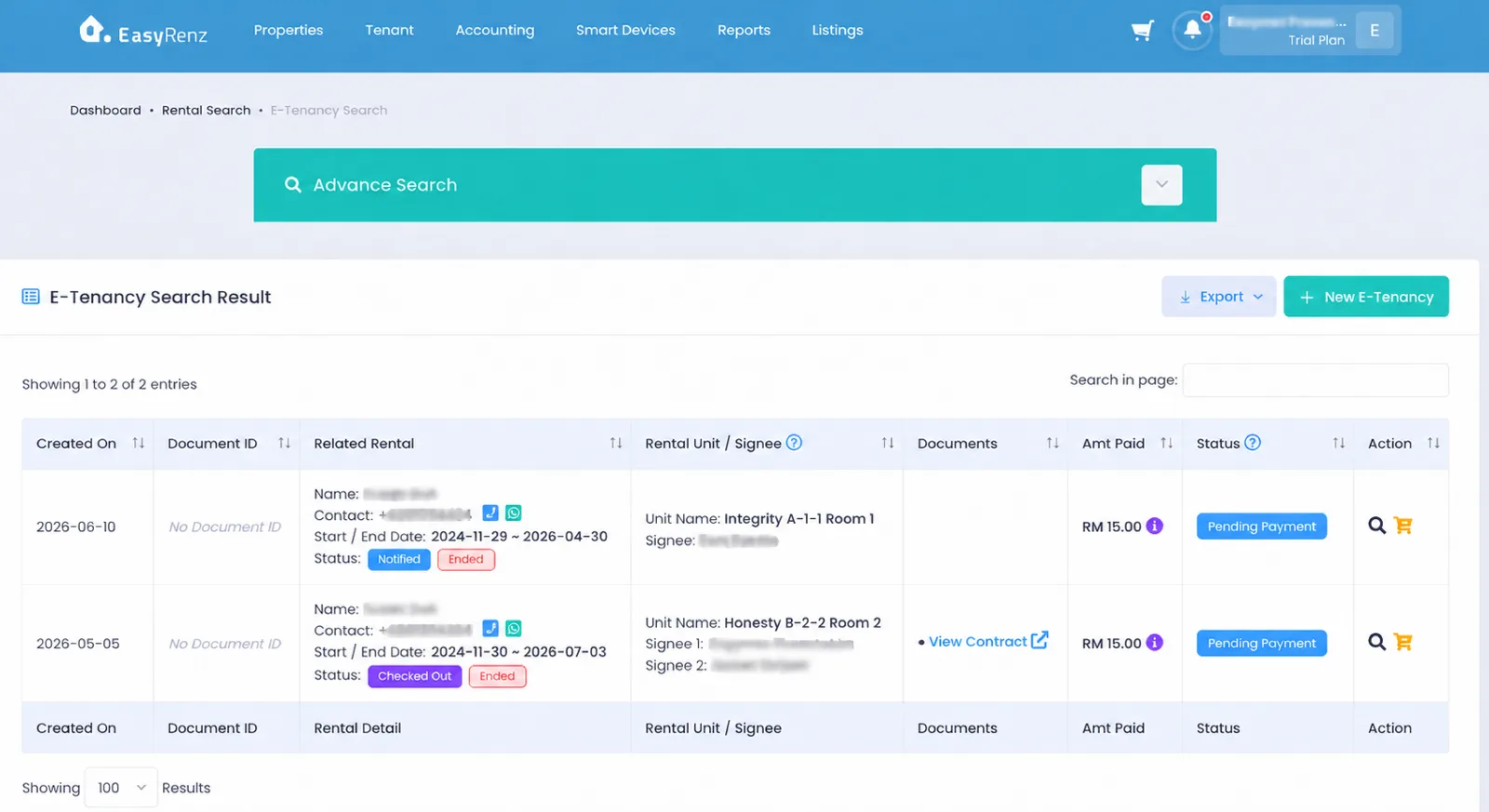
Whether the answer is a disciplined spreadsheet or dedicated software matters less than having one system that holds due dates, payments, documents and maintenance history in the same place.
The Pattern Underneath
Nine of these ten are the same mistake in different clothes: optimism substituted for process. The rent will arrive, the tenant will be fine, the aircon will hold out another year, the tenancy end date is months away.
Usually it does work out, which is exactly why the habit persists. The purpose of process is not to handle the ordinary case — it is to make sure the unusual one is discovered while it is still small. Landlords who check their position weekly find problems worth a few hundred ringgit. Landlords who check quarterly find the same problems worth a few thousand.
Ready To Simplify Property Management?
Manage properties, collect rent and track maintenance from one platform built for landlords, property managers and rental operators.